Entry Requirements and Arrival
Visa
Citizens of most EU countries, the UK, the United States, Canada, and Australia can obtain a visa on arrival at Cairo, Luxor, Hurghada, and Sharm el-Sheikh airports. The fee is USD 25, payable in foreign currency at the airport bank before reaching immigration. E-visas are available in advance online and are valid for 30 days (single entry) or 90 days (multiple entry). Check the Egyptian Ministry of Foreign Affairs or your government's travel advisory for your specific nationality — the list of visa-on-arrival eligible countries changes periodically.
Cairo International Airport to the City
Cairo International Airport is approximately 22 kilometres northeast of central Cairo. The Cairo Metro Line 3 connects the airport to central Cairo stations (Al-Ahram, Bab el-Sha'riya, etc.) for EGP 20 — significantly cheaper and faster during peak hours than taxis. Rideshare apps (Uber, Careem) operate reliably from the arrivals area. Official white airport taxis are metered but negotiate a fare before entering if taking a non-metered cab.
Currency and Payments
The Egyptian Pound (EGP) is the local currency. As of 2026, major archaeological site tickets and many hotels quote prices in EGP; some tourism-facing businesses quote in USD or EUR. International credit cards are accepted at larger hotels, major restaurants, and the GEM ticket office but are often not accepted at individual site ticket windows — carry sufficient local cash for daily site fees. ATMs are widely available in Cairo, Luxor, and Aswan city centres but less reliable in smaller locations. Withdraw cash at bank ATMs rather than hotel lobby machines for better rates.
Health
No vaccinations are required for entry, though Hepatitis A, Typhoid, and Tetanus are recommended by most travel health clinics for extended visits. Sun exposure at desert sites is a genuine hazard — high-SPF sunscreen, a wide-brimmed hat, and at least 2 litres of water per person per day outdoors in summer are non-negotiable, not suggestions. Stomach upsets are common; stick to bottled water, avoid ice in drinks outside of reputable establishments, and keep rehydration salts available.
Inter-City Transport
Sleeper and Day Trains
Egyptian National Railways operates trains between Cairo, Luxor, and Aswan. The overnight sleeper train from Cairo Ramses to Luxor takes 10–12 hours; to Aswan, 13–15 hours. AC sleeper berths include dinner and breakfast and provide comfortable overnight transport. Daytime express services are faster but can run late. Tickets are purchased at stations or online. The rail corridor along the Nile is one of the most reliable inter-city options for the main tourist route.
Domestic Flights
Egypt Air and Nile Air operate Cairo–Luxor, Cairo–Aswan, Luxor–Aswan, Cairo–Abu Simbel, and Cairo–Sharm el-Sheikh routes. Flight times of 1–1.5 hours replace 10-hour train journeys. Fares are higher than trains but are often reasonable by European comparison standards. Booking 4–6 weeks in advance significantly reduces prices. Luggage allowances are standard and the airports at Luxor and Aswan are small and efficiently navigated.
Nile Cruises
The 4- or 7-day Nile cruise from Luxor to Aswan (or reverse) remains one of the most rewarding formats for experiencing Upper Egypt. Cruises moor at Esna, Edfu (Horus Temple), Kom Ombo (double temple of Sobek and Haroeris), and Aswan, with guided visits at each stop. The quality of cruise vessels varies enormously — our full cruising guide rates the available vessels and compares itineraries. Avoid booking the cheapest options on the river; conditions differ significantly from mid-range upward.
Islamic Cairo and Coptic Cairo
Egypt's heritage extends well beyond the Pharaonic period. The Islamic Cairo district and the Coptic Cairo quarter both deserve serious attention, particularly for visitors spending three or more days in the capital.
Islamic Cairo
The medieval Islamic city around Khan el-Khalili bazaar and the Citadel of Saladin contains one of the highest concentrations of pre-Ottoman Islamic architecture in the world. Key sites include the Sultan Hassan Mosque-Madrassa (1356–1363), recognised as the greatest example of Mamluk architecture anywhere; the Al-Azhar Mosque (970 CE, the world's oldest university); the Citadel with the Muhammad Ali Mosque; and the Al-Muizz Street, which preserves a complete medieval commercial streetscape. Half a day is a minimum; a full day allows deeper exploration of the northern and southern cemetery areas.
Coptic Cairo
The Coptic quarter in Old Cairo includes the Hanging Church (Al-Muallaqah), built above the gatehouse of a Roman fortress; the Church of St. Sergius and Bacchus, built on the site tradition identifies as the Holy Family's shelter during the Flight into Egypt; and the Coptic Museum, housing the finest collection of Christian Egyptian art and manuscripts in the world, including the Nag Hammadi codices. Compact and walkable in 2–3 hours.
Alexandria in a Day or Three
Alexandria, founded by Alexander the Great in 331 BCE and capital of the Ptolemaic dynasty for three centuries, is a two-hour train ride from Cairo and worth including in any itinerary with five or more days in Egypt. The city's identity is layered — Greek, Roman, Jewish, Coptic, Arab, Ottoman, and 20th-century Cosmopolitan — and its heritage reflects all of these in close proximity.
Bibliotheca Alexandrina
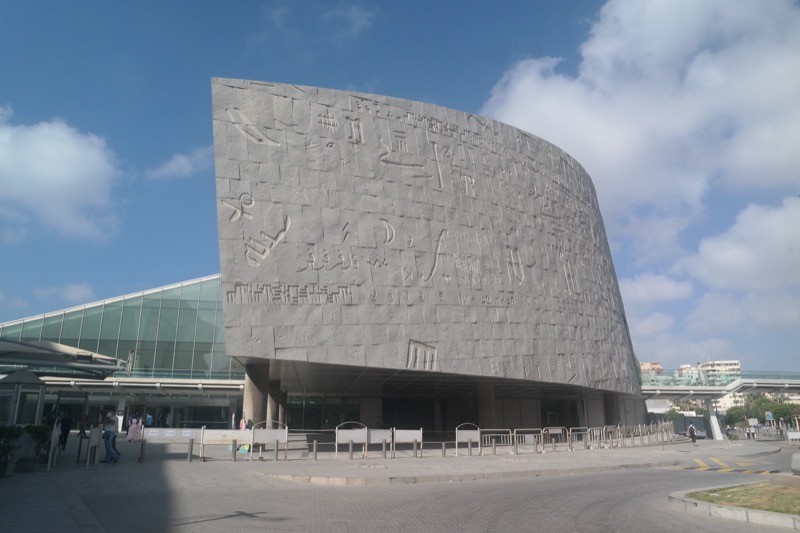
The modern Bibliotheca Alexandrina, inaugurated in 2002, occupies the proposed site of the ancient Library of Alexandria destroyed in the Roman period. The building itself — a tilted disc clad in Aswan granite inscribed with 120 writing systems — is architecturally remarkable. The complex houses multiple permanent museums including the Antiquities Museum (Graeco-Roman period), the Manuscript Museum, the Shadi Abdel Salam Museum (Egyptian film), and regular temporary exhibitions. Allow 2–3 hours minimum.
Catacombs of Kom el-Shoqafa
The largest Roman-period funerary complex in Egypt, discovered in 1900 when a donkey fell through the ground into the first chamber. Three levels of catacombs combine Egyptian, Greek, and Roman iconographic traditions in a visual fusion that is unique to Alexandria's cultural identity — the Triclinium dining hall and the principal tomb chamber show the three traditions intertwined in a single decorative programme. The deepest level is partially flooded; the upper levels are fully accessible. Entry: EGP 180.
Citadel of Qaitbay
The 15th-century Mamluk fort built on the foundations of the ancient Lighthouse of Alexandria (Pharos) — one of the Seven Wonders of the Ancient World. Granite blocks from the lighthouse, some bearing Pharaonic markings, are visible in the lower walls. The citadel sits at the tip of the Eastern Harbour with views back across the city's Mediterranean waterfront. Entry: EGP 120. The adjacent seafront corniche walk is one of the most pleasant in Egypt in cooler months.
For seasonal guidance on when to visit Alexandria, Luxor, Aswan, and Cairo, see our dedicated Seasonal Guide. For the Giza sites north of Cairo, see our Giza Plateau guide.
Questions About Your Specific Trip?
Our team answers practical planning questions for all members. If you are unsure about transport options, entry requirements for your nationality, or how to structure a multi-city itinerary, contact us or view our membership plans.
Send a Question