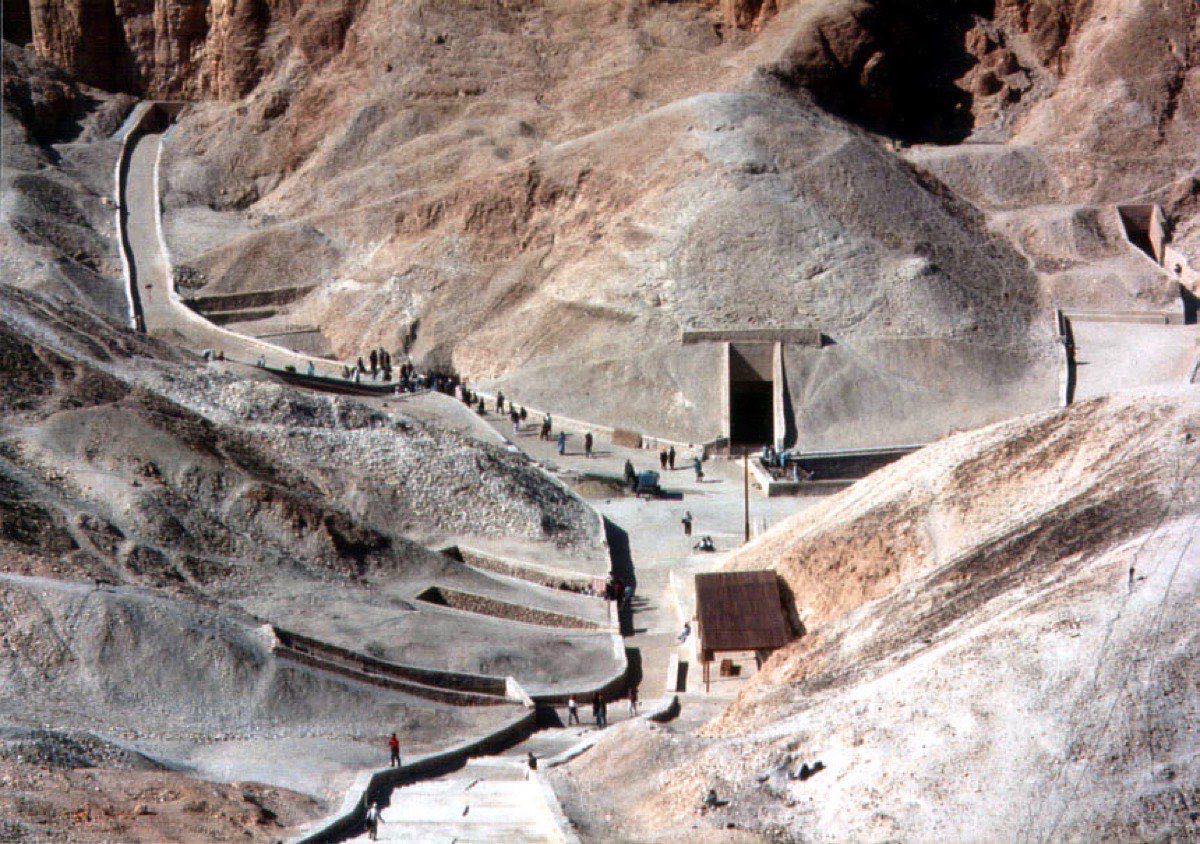
What You Are Visiting
The Valley of the Kings served as the burial place of Egypt's pharaohs from approximately 1539 BCE to 1075 BCE — covering the entire New Kingdom period, from the early 18th Dynasty through the 20th Dynasty. The choice of this remote valley in the Theban hills, rather than the pyramid field previously favoured, reflected both security concerns and the changing theological understanding of the afterlife.
The valley is divided into the East Valley (where the majority of open tombs are located) and the smaller West Valley (containing only two accessible tombs, including the unusual tomb of Ay). The standard visitor ticket covers three tombs of your choice in the East Valley, with Tutankhamun's tomb (KV62) and several other notable tombs requiring separate tickets.
The painted decorations inside the tombs represent the finest surviving examples of New Kingdom funerary iconography. The scenes are not ornamental — they are texts in visual form, drawn from the Book of the Dead, the Amduat, the Book of Gates, and related funerary compositions, each designed to guide the deceased pharaoh through the underworld to resurrection.
For the East Bank temples of Luxor and Karnak, see our Luxor Temples guide.
Key Open Tombs — What Each Offers
The standard ticket covers three tombs. The following are currently open and represent the most instructive choices for different visitor priorities. Access status is verified monthly by our team.
Ramesses VI — Best Overall
One of the largest and most completely decorated tombs in the valley, built for the 20th Dynasty pharaoh Ramesses VI. The astronomical ceiling of the burial chamber — showing the full cycle of day and night with the solar disk travelling through the body of the sky goddess Nut — is among the finest painted surfaces in Egypt. The tomb is long (104 metres) and well-lit. Recommended for all visitors as a first or second choice.
Seti I — Finest Decoration
The most elaborately decorated tomb in the valley, built for the 19th Dynasty pharaoh Seti I, father of Ramesses II. The painted reliefs here are exceptional in their detail and preservation — the blue-toned palette, the precision of the hieroglyphic carving, and the narrative scope place this tomb in a different artistic category from others in the valley. Requires a separate ticket (currently EGP 1,000). Worth it for visitors with specific interest in Egyptian art.
Ramesses III — Unusual Scenes
The burial complex of the last great pharaoh of the New Kingdom is notable for its side chambers containing unusual scenes of daily life — musicians, blindfolded men, boats — rare in a royal tomb context. The tomb was begun by Setnakhte (who abandoned it after breaking into a previous tomb) and completed by his son. It is one of the wider tombs with good visitor circulation even when busy.
Tutankhamun — Famous, Not the Best
The most famous tomb in the valley is, architecturally and artistically, one of the smallest and least impressive — precisely because Tutankhamun's early death meant his larger intended tomb was never finished. What you see is the burial chamber with the king's quartzite sarcophagus (the outer coffin and mummy remain in situ) and minimal wall decoration. Worth visiting for its historical significance, but the painted decoration at KV9 or KV17 is far superior. Separate ticket: EGP 300.
Amenhotep II — Royal Mummies
This tomb became a cache for royal mummies in the Third Intermediate Period, when priests reburied displaced royal bodies to protect them from robbers. When discovered in 1898, it contained the mummies of several New Kingdom pharaohs, including Amenhotep III, Merenptah, and the mysterious "Elder Lady" (now identified as Queen Tiye). The mummies have since been moved to Cairo; the tomb's elaborate astronomical shaft and well room are exceptional. Requires additional ticket.
Ramesses IV — Good for Groups
One of the widest and most accessible tombs in the valley, with a relatively short corridor and a large burial chamber containing the massive granite sarcophagus of Ramesses IV. The ceiling texts include unusual cosmological diagrams. This tomb circulates visitors more easily than the narrower shafts and is recommended as a third choice when the valley is busy, as it provides a good overview without severe bottlenecking.
The Broader West Bank
Deir el-Bahari — Hatshepsut's Temple
The mortuary temple of Queen Hatshepsut (1479–1458 BCE) is carved into the cliffs of Deir el-Bahari approximately 500 metres from the Valley of the Kings. Its three colonnaded terraces, connected by ramps, are among the most photogenic structures in Egypt. The painted reliefs — particularly those depicting the divine birth of Hatshepsut and the trading expedition to Punt — are among the most important historical documents from the New Kingdom. Entry: EGP 240. See also Luxor and Karnak for the East Bank context.
Medinet Habu — Ramesses III Memorial Temple
The mortuary temple of Ramesses III is the best-preserved temple in the Theban area after Karnak. Its entrance gate (a fortified tower modelled on Syrian military architecture) is unique in Egypt, and the external walls carry some of the most detailed battle reliefs in existence, showing the defeat of the Sea Peoples in the early 12th century BCE. Medinet Habu is consistently less visited than Karnak and Luxor Temple and offers a more reflective experience. Entry: EGP 200.
Colossi of Memnon
Two seated quartzite statues of Amenhotep III, originally flanking the entrance to his (now largely destroyed) mortuary temple. The northernmost statue became famous in antiquity for the sound it produced at sunrise — identified as the cry of the Greek hero Memnon — until the crack in the stone responsible was repaired by Septimius Severus in the 2nd century CE. They are freely visible from the road and are typically a brief stop on a West Bank day.
Nobles' Tombs
The tombs of the senior court officials and priests buried in the hills behind Luxor preserve the most detailed paintings of daily New Kingdom life — agricultural scenes, feasting, workshops, hunting, fishing — that survive anywhere. The tombs of Nakht (TT52), Menna (TT69), Sennefer (TT96), and Rekhmire (TT100) are among the most accessible. Entry tickets are separate and cheaper than the royal valley. Our West Bank guide covers the full set of currently open tombs.
Planning a West Bank Day?
Our full West Bank guide includes a suggested one-day and two-day itinerary, current tomb access status with monthly updates, ferry and transport logistics from Luxor East Bank, and accessibility notes for all major sites. Available with Traveller and Expedition plans.
Get the Full Guide